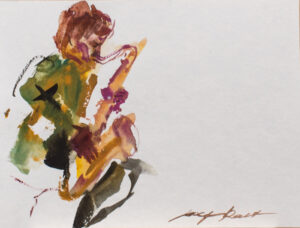
The theme of the work of Art
When we choose an object to paint or draw, it is not enough to do so without trying to say something that moved us to express it in the first place.
In my classes, especially with beginner students, they quite frequently ask me what we should paint today.
I have usually answered that I don’t know, since it depends on what you want to say.
Choosing a nice bouquet of flowers is not enough.
We have to feel what that specific flower wants to communicate.
If it’s a rose, then is it a sad rose with its head slanted down?
Is it a rose from a loved one we have just received, as an invitation to a romantic dinner?
Do the heavy clouds on the horizon foretell a storm?
A happy sky declaring, life is worth living?
The forms talk to us.
There is no neutral form. We may be in a neutral mood, and that is all right, but the Chinese and Japanese masters always insisted that one should never paint something that is not on one’s mind and heart.
This is actually one of the oldest and most persistent themes in Chinese painting theory, going back over a thousand years.
The single most direct saying comes from Zhang Zao, a Tang dynasty painter: — “Outwardly, learn from creation [nature]; inwardly, draw from the wellspring of the heart-mind.” It’s often treated as the founding statement of the whole tradition — that a painting has to be earned twice, once through real observation of the world, and once through inward transformation, and neither alone is enough.
The bamboo story is probably its most vivid illustration Su Shi (Su Dongpo) wrote of watching his friend Wen Tong paint bamboo, and coined the phrase — “to already have the bamboo complete in one’s breast” — meaning Wen Tong had watched bamboo through wind, rain, snow, and every season for so long that the whole living plant existed inside him before the brush ever touched silk. Painting, in that account, is just the moment the already-formed image is released — not a moment of invention at the easel.
Guo Xi, a Song dynasty landscape painter, wrote a treatise called Linquan Gaozhi (“The Lofty Message of Forests and Streams”) that speaks almost exactly to your “right season” point. He describes how a mountain changes character through the year — paraphrased, spring mountains are light and delicate, as if smiling; summer mountains are lush and heavy, as if dripping with moisture; autumn mountains are clear and bright, as if freshly composed; winter mountains are bleak and still, as if sleeping.
He insisted that a painter must have lived among mountains and walked them in every season and weather before attempting to paint them at all—anything less is decoration, not painting.