The Dao of the Flowing Brush
A natural way to enhance your creative skills.
The Dao of the Flowing Brush is a course in drawing, painting, and visual thinking. It teaches the fundamentals of art through traditional techniques, the observation of nature, and the spontaneous expression of inspired emotions, moods, and visual thought forms.
Over many years of teaching—in art institutions and privately in my own studio—I came to see a persistent limitation in how art is taught. Instruction tends to begin with technique and materials and to place vision and inspiration last, if it arrives at them at all. The order is reversed. What should come first is left for the student to discover alone, or never.
This reversal has a real cost. A student may complete three or five years of study — a full BFA among them — and still not know how to express what is uniquely theirs: a personal vision, a voice, work that means something both to the one who makes it and to the one who sees it.
Slowly it became clear to me why. When we teach tools, materials, and techniques before the student has tasted inspiration, wonder, and flow, we build the craft on empty ground. The hand grows skilled while the vision stays silent. The work that follows may be competent, but it is without conviction — uncertain of its own direction, leaning on convention and on whatever trend is in fashion, because it has nothing of its own to lean on.
This is when I discovered the Chinese philosophy of the Dao.
The Dao offered me not another technique to set beside the rest. It was something the teaching of craft can never give: a picture of creation itself as a living flow. In the Daoist view, all things arise from an undivided source — from emptiness and stillness — and unfold, in natural stages, down into form. Nothing is assembled; everything grows.
When I saw this, I recognized it, because it was the very order I had watched my best students follow by instinct—beginning in openness and wonder, letting an inspiration take hold, and only then shaping it, refining it, and releasing it into the world. The Dao did not teach me something foreign. It named what I had already seen.
I will say only in passing — for it is not the subject of this course — that the same shape, a single source descending through its own stages into the living world, lies at the heart of the mystical tradition I myself come from. Seekers in very different times and places found the same pattern. I stand in more than one of those places, and here I put the pattern to work at the easel.
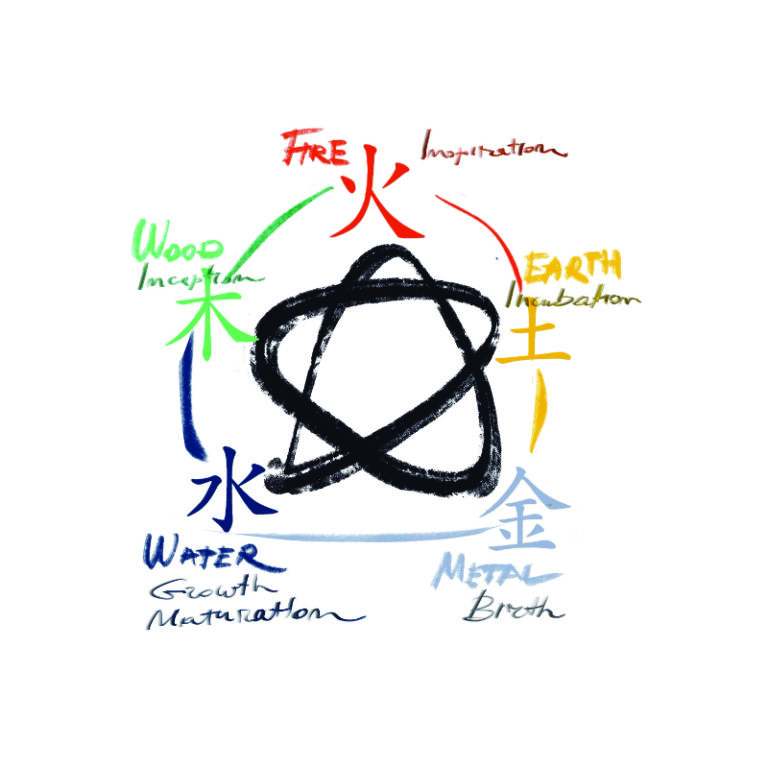
To make it usable — to turn a philosophy into something a painter can actually do — I follow the Daoist map of the Five Phases, the Wuxing: the five movements through which the undivided source becomes a finished, living work.
Each phase of the creative act has its own character, task, and danger, and the painter who knows which phase the work is in is never lost or working blindly.
What those five phases are, how each flows into the next, and how each is practiced with the brush in hand — this is the substance of the course, and it cannot be grasped from an introduction alone.
The video classes that follow show it step by step, where the cycle comes to life in the actual work of drawing and painting. The student who might once have finished years of study still unable to speak in a voice of their own is given, instead, a way to find it — not by abandoning technique, but by restoring it to its rightful place, in the service of vision rather than ahead of it.
Read what follows, then, not as a theory to be believed, but as a door. The teaching itself waits on the other side.