Wood — Inception — Mu (木)
The Awakening of Curiosity, The Beginning of Exploration
The element of Wood is perhaps the most natural place to begin exploring the creative cycle.
A wheel has neither beginning nor end, yet we must enter it somewhere. Inception, the awakening of curiosity and the first movement toward discovery, offers us a natural starting point.
As we have discussed in the introduction, Inception precedes Conception, which belongs to the Fire phase. Before an idea can take shape, before inspiration can ignite, something must awaken our curiosity.
This awakening begins with the meeting of opposites.
The subjective self reaches outward toward objective reality. The familiar encounters the unknown, the inner world meets the outer world, and a creative tension arises between them.
This tension is not necessarily a conflict. Rather, it is a desire for relationship, balance, and harmony.
The Wood phase is characterized by a playful dance of exploration. Curiosity about the unknown encourages us to reach beyond ourselves, initiating communication and interaction with the world around us.
This initial encounter plants the seed of creation.
Wood in Nature — The Seed of Creation
In traditional Chinese understanding of Wu Xing, Wood represents the expansive, outward-moving energy of spring.
After winter’s stillness, life stirs. Seeds germinate, roots reach downward, and tender shoots push upward toward the light.
This natural process offers a beautiful analogy for creativity.
A seed contains the potential for future growth, but it cannot develop in isolation. It needs the support and interaction of other conditions.
The Earth provides the soil in which it takes root. Water supplies moisture. Fire, represented by the sun’s warmth and light, stimulates growth. Metal, associated here with the minerals within the soil, contributes to its nourishment.
Thus, even at the beginning of the Wood phase, all five elements are already participating.
This is an essential principle of our approach: the phases of transformation are not isolated steps but interacting qualities within a living, continuous process.
Although Wood predominates at this moment, the other phases remain present, each contributing its particular character to the emergence of new life.
Wood in Painting — The Art of Exploration
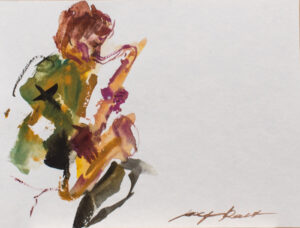
In drawing and painting, the Wood phase finds its most immediate expression in the artist’s first encounter with the subject.
Before deciding what a painting should become, we begin by looking, observing, questioning, and exploring.
The artist’s hand moves across the paper, searching for relationships between forms, directions, movements, and spaces.
At this stage, sketching is not necessarily about producing a successful drawing. It is to establish communication with the subject.
A quick gesture, a tentative line, or a spontaneous brushstroke can reveal something that careful planning might overlook.
The artist begins to discover possibilities rather than impose predetermined conclusions.
This playful interaction is fundamental to the creative process.
And although our course concentrates on drawing and painting, the same principle applies far beyond the visual arts.
A musician explores a melody, a chef experiments with flavors, an architect investigates a space’s possibilities, and a gardener observes the soil’s needs and potential.
In every case, creativity begins with curiosity and the willingness to enter into a relationship with something not yet fully understood.
You are invited to consider how this phase of exploration manifests itself within your own field of experience.
The Fear of the First Mark
During my many years of teaching, I have frequently encountered a particular difficulty among beginning students: the fear of making mistakes.
Faced with an empty sheet of paper, the student often becomes hesitant. The hand tightens, the line loses its vitality, and the drawing begins without conviction.
Instead of exploring the subject’s possibilities, the student tries too quickly to produce a successful result.
This premature desire for completion interrupts the natural flow of creativity.
The student may choose the first composition almost arbitrarily, without allowing enough time for exploration or for the inspiration of the Fire phase to develop.
The result is often a drawing that lacks a clear sense of purpose, personal engagement, or expressive direction.
The student becomes concerned with correctness before discovering what is worth expressing.
I believe one of an art teacher’s most important tasks is to help students rediscover the freedom to explore.
A spontaneous gesture drawing, an experimental composition, or a few playful brushstrokes can release the hand from its hesitation.
The apparent mistake may become an unexpected discovery.
In the Wood phase, we are not yet concerned with reaching the finish line. We are learning to enjoy the journey of discovery.
Wood and Metal — Freedom and Discipline
Yet exploration without direction can also become endless.
The expansive energy of Wood, if left entirely unrestricted, may lead the artist to wander from one possibility to another without developing a coherent intention.
Here we encounter the important relationship between Wood and Metal.
Within the controlling cycle of Wu Xing, Metal restrains Wood.
In the creative process, this relationship can be understood as the balancing influence of discipline, selection, and refinement upon spontaneous exploration.
Metal does not need to suppress Wood. Its role is to provide a necessary boundary within which Wood can flourish.
Just as pruning may guide a tree’s growth, thoughtful selection can help the artist distinguish between possibilities that contribute to the emerging work and those that lead away from it.
This interaction reveals an important aspect of the five phases: each phase relates to all the others, even when one quality predominates.
The freedom of Wood and the discipline of Metal are not enemies. They are complementary forces whose interaction makes creative development possible.
Inception and the Flow of Creativity
The Wood phase teaches us that creativity begins not with certainty, but with curiosity.
It asks us to approach the world with openness, to encounter the unfamiliar, and to allow possibilities to emerge before attempting to define them.
The first sketch, the first question, and the first spontaneous gesture express this outward-reaching energy.
From this initial encounter, the conditions for the next transformation gradually develop.
Curiosity awakens desire, possibilities suggest direction, and the first sparks of inspiration prepare the way for Fire.
But Wood does not disappear when Fire emerges. Its exploratory energy continues to nourish the creative process throughout the entire cycle.
The creative journey is not a straight line from beginning to end, but a living interaction of forces that continually transform one another.
A Practical Invitation — Exploring Without Judgment
Choose a simple subject that attracts your curiosity. It might be a person sitting in a café, a tree, an arrangement of objects, or a view through a window.
Make several quick sketches, allowing yourself no more than two or three minutes for each.
Do not attempt to produce a finished drawing.
Instead, explore different possibilities: change the viewpoint, exaggerate a movement, simplify a form, or follow the rhythm of a gesture.
Observe how each attempt reveals something you had not noticed before.
When you finish, look at the sketches together.
Rather than asking which one is the most correct, ask yourself:
Which sketch awakened my curiosity most strongly, and what might it invite me to explore next?
This is the spirit of Wood — the joy of discovering what might become possible.
From Wood to Fire — The Spark of Inspiration
Curiosity opens the door to discovery. Through exploration, observation, and playful encounters with the unknown, possibilities begin to emerge.
Gradually, something catches our attention. An unexpected relationship, a movement, a particular quality of light or color awakens our imagination.
Wood’s searching energy begins to transform into Fire’s illuminating energy.
Exploration gives birth to inspiration.
And so, we enter the next phase of our creative journey: Fire — Conception and Inspiration.