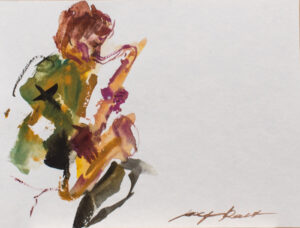
Fire-Conception and Inspiration
The spark of inspiration
Fire is the phase of inspiration: the moment when exploration catches light and a living idea emerges.
We sometimes encounter works of remarkable technical skill that nevertheless leave us unmoved. Everything seems accomplished, yet something feels absent. In the language of this course, what is missing is Fire—the felt conviction that gives technique direction and expression its vitality.
During Wood, we reach outward, explore, and question. In Fire, something answers. A relationship becomes clear, an image takes hold, or a possibility suddenly feels alive. What had been scattered begins to gather around an intention.
Conception: an idea comes alive
The word conception suggests both the forming of an idea and the beginning of new life. It is a useful metaphor for the creative moment: something comes into being through an encounter.
In painting, this may be an encounter between ourselves and a subject, between two colors, or between a gesture and the feeling it awakens.
Perception, emotion, and imagination participate together.
An idea need not arrive as a thought we can put into words; it may first appear as a rhythm, a color relationship, or a sense of the whole. In this broader sense, conception belongs to art far beyond the movement called Conceptual Art. A painting’s idea may live within the experience of seeing and making.
Illumination and recognition
Fire is also illumination—the “Aha!” experience, when something we have been searching for becomes clear.
Exploring Wood may be long, uncertain, and sometimes frustrating. Yet recognition can arrive with surprising ease. For a moment, the struggle falls away, and we feel a fresh sense of possibility
We may experience something similar when falling in love, encountering a breathtaking landscape, hearing music that moves us, or tasting a dish whose delicate balance surprises us. Something reaches us before we can fully explain why.
Within this creative cycle, Fire expresses an upward movement: a quickening, an opening, a feeling of being lifted. When the Muse touches our hand, even the brush may seem lighter.
The urgency of Fire
Inspiration is not always gentle or joyful. It can arrive as restlessness, tension, or a burning need to give something form. A poem, an image, or a painting may begin in discomfort that demands expression.
The quality of Fire is therefore more than excitement. It is the intensity of involvement: something matters enough to call us into action.
That intensity may produce a bold gesture or a quiet, intimate painting. Fire can burn brightly or glow beneath the surface.
Inviting the Muse
We cannot predict exactly where inspiration will come from or what shape it will take. Often, we sense a direction before we can name a destination. We recognize what does not belong, while what we seek remains elusive.
Then something appears, and we recognize it—even though we could not have described it beforehand.
This uncertainty makes room for discovery. If the result were fully known in advance, little would remain to discover through painting.
We cannot command the Muse, but we can make ourselves available to her. Looking closely, playing with materials, returning to a sketch, listening to music, or allowing time away from a difficult painting may prepare the ground.
For our practice, the invitation is simple: notice what catches your attention and gives you the impulse to respond. Make a few marks, try a color relationship, or sketch the emerging whole. Let the idea begin to speak before asking it to explain itself completely.
As this spark develops, it needs grounding and nourishment. This brings us to Earth,